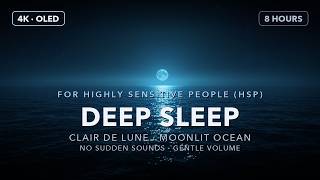
Deep Sleep Music for Highly Sensitive People (HSP) 🌙 4K OLED · 8 Hours · No Sudden Sounds
リアクション
2026年06月24日
Made for Highly Sensitive People (HSP) — if the smallest sound or a too-bright screen
wakes you, this is for you. Clair de Lune ("moonlight") over a calm, moonlit ocean,
filmed for 4K OLED screens: eight hours of soft, slow piano and gentle sea, with no
sudden sounds, no loud spikes, and no jarring transitions. Just a steady, sensitive calm.
🌙 What you’re watching
• A seamless, gently looping moonlit ocean in true 4K (3840×2160), graded dark and
deep for OLED — rich blacks, no harsh highlights, easy on the eyes in a dark room.
• 8 full hours — long enough for a whole night.
🔉 Made gentle on purpose
• No sudden sounds, no ads-style spikes, no sharp transitions — the volume stays steady
for the first hour, then drifts down very gradually and falls silent by the 5‑hour mark.
• The screen slowly dims to pure black at 5 hours, so a bright OLED panel won’t light up
your room (and stays gentle on the display) while you sleep through the night.
🎹 The music
• Debussy’s “Clair de Lune” (Suite bergamasque), a public-domain classic, in a soft,
reverb-washed arrangement chosen for calm and familiarity.
🛏️ How to use
• Set a comfortable, low volume. Press play, dim your lights, and let the moonlight do the
rest. Best on a TV or monitor in a dark room.
🕐 Timeline
0:00 Clair de Lune begins · full volume
1:00:00 Volume starts a slow, gentle fade
4:58:00 Screen begins dimming to black
5:00:00 Screen off · silence — sleep through to 8:00:00
A note: this is relaxing background music to help you unwind and drift off — it is not
medical treatment and makes no health claims. If you have a sleep disorder, please talk
to a professional.
📚 Why this is built for highly sensitive people — and how it's meant to work
High sensitivity (sensory-processing sensitivity, SPS) isn't fragility — it's a measurable trait in
about 20–30% of people, defined by Elaine Aron's "DOES" model and a validated DOES Scale (2024,
Journal of Personality Assessment): Depth of processing, Overstimulation, Emotional reactivity, and
Sensing the subtle.
Two of those explain the hard part. Depth of processing: a sensitive brain works each stimulus over
more thoroughly — Acevedo & Aron (2014, Brain & Behavior) found stronger fMRI activation in regions
for awareness and sensory integration, and Greven et al. (2025, Trends in Cognitive Sciences)
describe the brain assigning unusually high "precision" (weight) to every incoming signal. The cost
is Overstimulation: inputs that other people automatically tune out instead pile up, and over time
this load is linked to exhaustion and burnout (SPS → burnout: 2021, Frontiers in Psychology).
At night that becomes the problem. A nervous system that weighs and deep-processes everything can't
easily "let go" of the day's accumulated stimulation, and it keeps registering every faint leftover
cue — a flicker, a stray sound, the glow of a screen — as one more thing to process. It stays
switched on when it should be powering down.
So this video doesn't add soothing stimulation — it removes things to register. A few choices set
it apart, each aimed at the same mechanism:
• A genuinely event-free image — one continuous loop with no scene change, no cut, and (unlike
ordinary looped or AI backdrops) no visible loop point and no motion that ever "rewinds." We
verify the seam frame by frame, so a sensitive visual system never catches a repeat to react to.
• Sound engineered for sensitive ears, not just uploaded — every note onset is softened so nothing
ever "stabs," the piercing 3–4 kHz band where hearing is sharpest is eased back, and a
barely-there continuous bed gently masks the small clicks and creaks of a quiet room, giving a
high-precision auditory system fewer stray cues to catch. There are deliberately no binaural or
"brainwave" tones — to a sensitive system, a steady tone is just one more thing to track.
• Nothing interrupts — no mid-roll ads, ever. The most jarring "sudden sound" a sensitive sleeper
can get is an ad firing at 2 a.m., so there are none.
• The screen doesn't just dim — it fades to true black, so on OLED the pixels switch off and even
the faint glow stops being a cue.
The aim is "nothing new to predict, nothing to weigh," so a high-precision system can finally
downshift toward sleep.
That's the design rationale — a hypothesis grounded in real, peer-reviewed studies that describe
group-level findings about the trait. It is not medical treatment and not a promise of any result.
DOES Scale 2024 https://doi.org/10.1080/00223891.2024.2405536 · Acevedo & Aron 2014 https://doi.org/10.1002/brb3.242 · Greven 2025 https://doi.org/10.1016/j.tics.2025.10.007 · SPS & burnout 2021 https://doi.org/10.3389/fpsyg.2021.751350
#hsp #highlysensitiveperson #sleepmusic #clairdelune #4koled #oceansounds #deepsleep #relaxingmusic #debussy #8hours
wakes you, this is for you. Clair de Lune ("moonlight") over a calm, moonlit ocean,
filmed for 4K OLED screens: eight hours of soft, slow piano and gentle sea, with no
sudden sounds, no loud spikes, and no jarring transitions. Just a steady, sensitive calm.
🌙 What you’re watching
• A seamless, gently looping moonlit ocean in true 4K (3840×2160), graded dark and
deep for OLED — rich blacks, no harsh highlights, easy on the eyes in a dark room.
• 8 full hours — long enough for a whole night.
🔉 Made gentle on purpose
• No sudden sounds, no ads-style spikes, no sharp transitions — the volume stays steady
for the first hour, then drifts down very gradually and falls silent by the 5‑hour mark.
• The screen slowly dims to pure black at 5 hours, so a bright OLED panel won’t light up
your room (and stays gentle on the display) while you sleep through the night.
🎹 The music
• Debussy’s “Clair de Lune” (Suite bergamasque), a public-domain classic, in a soft,
reverb-washed arrangement chosen for calm and familiarity.
🛏️ How to use
• Set a comfortable, low volume. Press play, dim your lights, and let the moonlight do the
rest. Best on a TV or monitor in a dark room.
🕐 Timeline
0:00 Clair de Lune begins · full volume
1:00:00 Volume starts a slow, gentle fade
4:58:00 Screen begins dimming to black
5:00:00 Screen off · silence — sleep through to 8:00:00
A note: this is relaxing background music to help you unwind and drift off — it is not
medical treatment and makes no health claims. If you have a sleep disorder, please talk
to a professional.
📚 Why this is built for highly sensitive people — and how it's meant to work
High sensitivity (sensory-processing sensitivity, SPS) isn't fragility — it's a measurable trait in
about 20–30% of people, defined by Elaine Aron's "DOES" model and a validated DOES Scale (2024,
Journal of Personality Assessment): Depth of processing, Overstimulation, Emotional reactivity, and
Sensing the subtle.
Two of those explain the hard part. Depth of processing: a sensitive brain works each stimulus over
more thoroughly — Acevedo & Aron (2014, Brain & Behavior) found stronger fMRI activation in regions
for awareness and sensory integration, and Greven et al. (2025, Trends in Cognitive Sciences)
describe the brain assigning unusually high "precision" (weight) to every incoming signal. The cost
is Overstimulation: inputs that other people automatically tune out instead pile up, and over time
this load is linked to exhaustion and burnout (SPS → burnout: 2021, Frontiers in Psychology).
At night that becomes the problem. A nervous system that weighs and deep-processes everything can't
easily "let go" of the day's accumulated stimulation, and it keeps registering every faint leftover
cue — a flicker, a stray sound, the glow of a screen — as one more thing to process. It stays
switched on when it should be powering down.
So this video doesn't add soothing stimulation — it removes things to register. A few choices set
it apart, each aimed at the same mechanism:
• A genuinely event-free image — one continuous loop with no scene change, no cut, and (unlike
ordinary looped or AI backdrops) no visible loop point and no motion that ever "rewinds." We
verify the seam frame by frame, so a sensitive visual system never catches a repeat to react to.
• Sound engineered for sensitive ears, not just uploaded — every note onset is softened so nothing
ever "stabs," the piercing 3–4 kHz band where hearing is sharpest is eased back, and a
barely-there continuous bed gently masks the small clicks and creaks of a quiet room, giving a
high-precision auditory system fewer stray cues to catch. There are deliberately no binaural or
"brainwave" tones — to a sensitive system, a steady tone is just one more thing to track.
• Nothing interrupts — no mid-roll ads, ever. The most jarring "sudden sound" a sensitive sleeper
can get is an ad firing at 2 a.m., so there are none.
• The screen doesn't just dim — it fades to true black, so on OLED the pixels switch off and even
the faint glow stops being a cue.
The aim is "nothing new to predict, nothing to weigh," so a high-precision system can finally
downshift toward sleep.
That's the design rationale — a hypothesis grounded in real, peer-reviewed studies that describe
group-level findings about the trait. It is not medical treatment and not a promise of any result.
DOES Scale 2024 https://doi.org/10.1080/00223891.2024.2405536 · Acevedo & Aron 2014 https://doi.org/10.1002/brb3.242 · Greven 2025 https://doi.org/10.1016/j.tics.2025.10.007 · SPS & burnout 2021 https://doi.org/10.3389/fpsyg.2021.751350
#hsp #highlysensitiveperson #sleepmusic #clairdelune #4koled #oceansounds #deepsleep #relaxingmusic #debussy #8hours