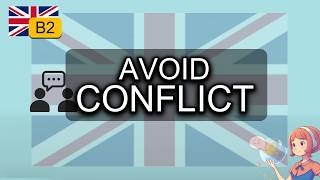
English B2: How Native Speakers Disagree Politely and Avoid Conflict
リアクション
2026年09月01日
Learn how native English speakers disagree without sounding rude, harsh, or confrontational. In this English B2 lesson, you will hear a dialogue-based conversation that teaches natural, respectful ways to avoid conflict, soften refusals, and handle tense moments in English.
This lesson focuses on the real phrases people use in everyday conversations, work discussions, and awkward social situations. You will learn how expressions like I see what you mean, I am not convinced, and That might be difficult can help you disagree politely while keeping the conversation calm and respectful.
Because the lesson uses a dialogue format, you will not just memorize phrases. You will hear them in context, with repeated examples and clear explanations, so you can understand the meaning, tone, and timing behind each expression. This helps you sound more natural and more like a native speaker when conversations become sensitive or emotional.
In this video, you will learn:
How to disagree politely in English
How to soften a refusal
How to show partial agreement
How to calm a tense conversation
How native speakers use indirect language
How tone and timing change meaning
How to protect relationships while expressing a different opinion
This lesson is useful for English learners who want to improve speaking, listening, conversation skills, and pragmatic fluency at the B2 level. It is especially helpful if you want to sound diplomatic, professional, and natural in real-life English.
Perfect for:
B2 English learners
Intermediate English students
English conversation practice
Polite English phrases
Business English communication
Everyday spoken English
Listening and speaking improvement
Natural English expressions
Conflict resolution in English
Disagreeing politely in English
If you want to speak English more confidently in difficult conversations, this lesson will help you understand how native speakers stay respectful while still being honest.
Subscribe to @BabelBoosters for more English listening practice, dialogue lessons, and natural spoken English for real conversations.
Copyright & Disclaimer
© 2026 Babel Boosters. All rights reserved.
This content is provided for educational and entertainment purposes only. It may contain AI-generated, fictionalized, speculative, randomized, or otherwise non-factual elements and should not be relied upon as legal, financial, medical, investment, technical, or other professional advice. Do not make decisions or take actions based on this content. Voice generated using Coqui TTS (VITS) with speakers from the CSTR VCTK Corpus (CC BY 4.0). Re-uploading, copying, redistributing, selling, republishing, or commercially exploiting this content, in whole or in part, without prior written permission is prohibited.
This lesson focuses on the real phrases people use in everyday conversations, work discussions, and awkward social situations. You will learn how expressions like I see what you mean, I am not convinced, and That might be difficult can help you disagree politely while keeping the conversation calm and respectful.
Because the lesson uses a dialogue format, you will not just memorize phrases. You will hear them in context, with repeated examples and clear explanations, so you can understand the meaning, tone, and timing behind each expression. This helps you sound more natural and more like a native speaker when conversations become sensitive or emotional.
In this video, you will learn:
How to disagree politely in English
How to soften a refusal
How to show partial agreement
How to calm a tense conversation
How native speakers use indirect language
How tone and timing change meaning
How to protect relationships while expressing a different opinion
This lesson is useful for English learners who want to improve speaking, listening, conversation skills, and pragmatic fluency at the B2 level. It is especially helpful if you want to sound diplomatic, professional, and natural in real-life English.
Perfect for:
B2 English learners
Intermediate English students
English conversation practice
Polite English phrases
Business English communication
Everyday spoken English
Listening and speaking improvement
Natural English expressions
Conflict resolution in English
Disagreeing politely in English
If you want to speak English more confidently in difficult conversations, this lesson will help you understand how native speakers stay respectful while still being honest.
Subscribe to @BabelBoosters for more English listening practice, dialogue lessons, and natural spoken English for real conversations.
Copyright & Disclaimer
© 2026 Babel Boosters. All rights reserved.
This content is provided for educational and entertainment purposes only. It may contain AI-generated, fictionalized, speculative, randomized, or otherwise non-factual elements and should not be relied upon as legal, financial, medical, investment, technical, or other professional advice. Do not make decisions or take actions based on this content. Voice generated using Coqui TTS (VITS) with speakers from the CSTR VCTK Corpus (CC BY 4.0). Re-uploading, copying, redistributing, selling, republishing, or commercially exploiting this content, in whole or in part, without prior written permission is prohibited.